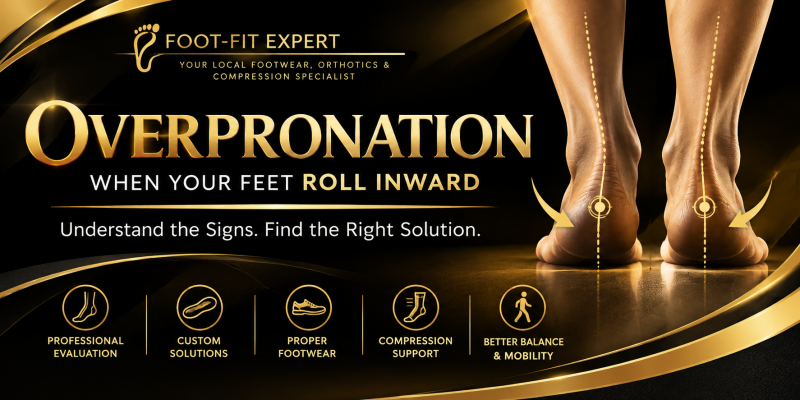
Overpronation: A Term You’ve Heard. But What Does It Actually Mean?
You may have been told you “overpronate,” that your arches “collapse,” or that you need more support.
But what does overpronation actually mean?
And more importantly, does it explain your foot pain, knee pain, balance issues, or shoe wear?
At Foot-Fit Expert, we look beyond the label. We evaluate how your feet, footwear, activity, and movement work together to determine whether your pronation pattern is actually affecting your comfort or function.
Understand the movement. Find the right solution.
What Is Pronation?
Pronation is a normal part of walking.
When your foot hits the ground, it naturally rolls inward to help absorb shock and adapt to the surface beneath you.
That movement is not automatically a problem.
The issue is when the amount, timing, or pattern of pronation may be contributing to discomfort, instability, inefficient movement, or excessive stress elsewhere in the body.
So What Is Overpronation?
Overpronation generally refers to more inward rolling of the foot than is ideal for an individual’s movement pattern.
You may notice signs such as:
-
Your arches appear to flatten when standing
-
Your ankles seem to roll inward
-
Your shoes wear more heavily on the inside
-
You feel unstable when walking or standing
-
Your feet become tired after prolonged standing
-
You experience foot, ankle, knee, or lower-leg discomfort
-
Certain shoes feel difficult to wear comfortably
But here's the important part:
Shoe wear or flat-looking arches alone don't tell the whole story.
Two people can have similar looking feet and completely different functional needs.
Overpronation Doesn't Always Mean Something Is Wrong
This is one of the biggest misconceptions about pronation.
Pronation itself is not bad.
Your feet are designed to move.
The goal isn't necessarily to stop your foot from pronating. The goal is to determine whether your movement pattern is creating a problem, and whether footwear or orthotic support could help.
That's why simply buying the most rigid or supportive shoe isn't always the answer.
The right amount of support depends on the individual.
What Can Overpronation Affect?
When excessive or poorly controlled pronation is associated with symptoms, the effects may extend beyond the foot.
Depending on the individual, it may be associated with:
Feet & Arches
Arch fatigue, soreness, or a feeling that your feet are working too hard.
Ankles & Lower Legs
Instability, fatigue, or discomfort during prolonged walking or standing.
Knees
Changes in lower extremity alignment can influence how forces travel through the leg.
Hips & Movement
Your feet are part of a larger movement system. Changes at the foot can influence movement farther up the chain.
Balance & Stability
Foot position and footwear can play an important role in how stable you feel on your feet.
Is Overpronation Causing Your Pain?
Maybe. Maybe not.
That's why a label shouldn't be the starting point for choosing footwear or orthotics.
At Foot-Fit Expert, we consider:
Your Feet
Arch structure, foot shape, pressure points, flexibility, and alignment.
Your Footwear
What you're currently wearing, how it fits, and how the shoe interacts with your foot.
Your Activity
Walking, running, work, standing all day, exercise, or daily mobility.
Your Symptoms
Where you hurt, when symptoms occur, and what makes them better or worse.
Your Goals
Comfort, stability, mobility, work performance, or simply being able to walk without constantly thinking about your feet.
Could Your Shoes Be Part of the Problem?
A shoe doesn't have to be uncomfortable when you first put it on to be the wrong shoe for you.
The wrong combination of:
-
Width
-
Heel structure
-
Arch location
-
Cushioning
-
Stability
-
Flexibility
-
Insole design
can make an existing movement problem harder to manage.
A professional footwear fitting looks at the relationship between your foot and the shoe, not just your shoe size.
When Orthotics May Help
Orthotics aren't simply “arch supports.”
A properly selected orthotic may help influence how your foot interacts with the ground and your footwear.
Depending on your needs, an orthotic may provide:
-
Arch support
-
Heel stability
-
Pressure redistribution
-
Improved foot positioning
-
Added comfort
-
A more consistent foundation inside the shoe
But not everyone who pronates needs custom orthotics.
Sometimes the right footwear or an appropriate prefabricated orthotic is all that's needed.
The goal is not to sell you the most expensive solution.
The goal is to find the solution that makes sense for your feet.
Stop Guessing. Start With an Evaluation.
If you've been told you overpronate, or you've noticed your arches collapsing, shoes wearing unevenly, or your feet becoming tired or painful there's a better way to figure out what's happening.
At Foot-Fit Expert, I evaluate your feet, footwear, activity, occupation, and mobility needs to help determine what type of support, footwear, or orthotic solution may be appropriate.
Refer → Assess → Recommend → Fit → Communicate
Your feet don't need a label. They need an individualized solution.